“It is a town,” said Mrs. Foltz. “It was meant to be, anyway. The developers never got any further than marking out lots and streets. What you see here is the result of speculation in the real estate market. It is a gamble gone badly, as it has for so many who bought land on credit. And for the capitalists who advanced it to them.”
The Deadly Stingaree, Chapter 17, The Long Road
In my most recent novel, The Deadly Stingaree, the protagonist Johnny Cong visits a town named Sombra de Oro. It isn’t much of a town, a one-room train station surrounded by empty, unimproved lots inhabited by rabbits, coyotes and crows. An English translation of Sombra de Oro would be something like “shadow of gold” or “golden shadow”. There were a lot of golden shadow towns in San Diego County in the the late 1800s, dusty remnants of the largest boom and bust real estate cycle in Southern California history.
How big of a boom and bust was it? Consider this. San Diego’s population was 2,637 in 1880. At the peak of the boom in 1887, the population had grown to 40,000. Two years after the crash began in 1888 the population had dropped back down to 16,159.
What caused the boom and the bust? The railroads. In 1885 the transcontinental railroad reached San Diego. The first train leaving San Diego departed on November 15. The first train from the east arrived six days later, on November 21.
Everyone agreed the railroad would bring more visitors to our sunny climes and that Eastern visitors, after taking in our Pacific Ocean views and the beautiful weather that went with it, would fall all over themselves to buy a house here. Ads were placed in Eastern newspapers. Get-rich-quick speculators arrived soon afterward. The race was on. Prices went through the roof.
Land auction in Coronado 1886 with numbered lots on the wall map.
At the height of the frenzy some properties were sold two or three times in the same day. So-called “developers” would buy large tracts of land and quickly subdivide them. Loan sharks and newly-minted banks were lending money at extravagant rates. Buyers who got in early and sold quickly made money. But those who got in late or held on to their properties too long lost their shirts.
What happened? Like all real estate bubbles, the rapid increase in prices was unsustainable. The market began to slow. Then came the real blow. The Santa Fe Railway moved its switch yards and repair facilities from National City (in south San Diego county) to San Bernardino. It also re-routed its railroad line to the coast. San Diego became the terminus of a spur line from Los Angeles instead of getting direct traffic from the east.
The original National City station, now a railroad museum
So the San Diego where Johnny Cong lives in 1891 is a city recovering from financial ruin. President Benjamin Harrison’s impending visit is a source of civic pride, a sign of hope that the city still matters.
There’d be more real estate bubbles and busts to come in San Diego history (I’ve lived through two of them) but none can compare to the original.
I own eight plots of land here in town. Not a single one of ‘em is worth what I paid for them.
On our recent vacation, my wife and I stopped to visit Grand Junction, the largest city (65,000+) on the western slope of Colorado, named for the joining of the Gunnison and Colorado rivers nearby. One attractive feature of the city is a pedestrian mall located in the historical downtown. As you stroll past shops and restaurants you’ll encounter various statues commissioned for the mall. One of these is the statue shown above—a man sitting in a bathtub, with a pencil, paper and makeshift desk. It’s a tribute to one of Grand Junction’s most famous sons—the screenwriter and novelist Dalton Trumbo.
Dalton TrumboTrumbo, with wife Cleo, at the HUAC hearings.
Trumbo was one of the most successful and well-paid Hollywood screenwriters of the 1930s and 40s but was blacklisted from working in Hollywood after appearing before the House UnAmerican Activities Committee (HUAC) in 1947 and refusing to name names of Communist sympathizers in the movie business. He spent a year in prison for contempt of Congress.
After his release from prison, he moved his family to Mexico, but continued writing scripts under various pseudonyms or fronted by other writers whose names went on the credits instead. Some of the scripts he wrote in that time included Roman Holiday and two noir classics, Gun Crazy and The Prowler. In 1960, the blacklist was officially broken when Kirk Douglas chose to list Trumbo’s name in the credits for Spartacus. Producer-Director Otto Preminger did the same for Trumbo’s screenwriting work on Exodus.
Trumbo was reinstated by the Writer’s Guild of America shortly after the release of those two movies. He continued to work in Hollywood, writing screenplays for Lonely are the Brave,Hawaii, Johnny Got His Gun (from his own anti-war novel) and Papillon, among others. He died in 1976 at the age of 70.
Now back to the statue. Trumbo’s family moved to Grand Junction in 1908, when he was 3 years old. As a teenager, he attended Grand Junction High School. While there, he began his writing career as a cub reporter for the local newspaper, The Daily Sentinel, which is still published today.
Commemorative plaque at the Daily Sentinel’s original location. Trumbo’s bathtub statue is directly across the street.
Current offices of The Daily Sentinel
The Trumbo family’s original home still stands today, located on a tree-lined street in a quiet neighborhood of Grand Junction (there are many quiet neighborhoods in Grand Junction).
Trumbo wasn’t always appreciated in his hometown, though. His first published novel, Eclipse, was a thinly-veiled social critique of Grand Junction (Shale City) society . The central character was based on Trumbo’s father and the financial struggles he endured during the family’s time there. A new edition published by the Mesa County Public Library Foundation in 2005 includes an addendum that matches Grand Junction residents of the time to characters in the book. With the passage of time, the novel’s harsh portrayal of the town lost its sting. Citizens began to appreciate the contributions to literature and cinema by one of their own. The Trumbo bathtub statue was installed and dedicated in 2007.
Why the bathtub?
Photo by Mitzi Trumbo
As the story goes, Trumbo developed physical ailments which were somewhat alleviated by a long hot bath. Unable and unwilling take it easy for any length of time, he decided to make the bathtub his work space as well. The 2017 biopic, Trumbo, starring Bryan Cranston, features several scenes with Trumbo (Cranston) writing in his bathtub.
In 1993, Trumbo was posthumously awarded an Oscar for his screenplay of Roman Holiday, originally credited to fellow screenwriter Ian McLellan Hunter to evade the blacklist (Hunter himself was later blacklisted).
A play based on Trumbo’s letters was produced Off-Broadway by his son, Christopher in 2003. Actors Nathan Lane, Tim Robbins, Brian Dennehy, Ed Harris, Chris Cooper and Gore Vidal(!) filled the role at various times.
A fountain at the University of Colorado (where Trumbo attended college for two years) was named in his honor.
Today, Dalton Trumbo is remembered for his uncompromising defense of free speech as well as his notable screenwriting career.
“Miss Sessions has a large nursery on the mesa. Perhaps she could help you.” “An excellent idea, Master Cong,” he said, turning back towards the hotel lobby. “We must go there immediately.”
Chapter 22, The Deadly Stingaree
Kate Sessions, San Francisco, 1857
If you were to visit San Diego in 1891, the year The Deadly Stingaree takes place, you would see few, if any, of the trees you find here today. Sagebrush and other scrubby plants covered the hills. There were no eucalyptus, pine, oak, cypress and pepper trees. The proliferation of those trees and many other plants is largely due to the work of one remarkable woman—Kate Sessions.
Sessions was born in San Francisco, California in 1857. She graduated from UC Berkeley in 1877 with a degree in natural science. In 1883 she moved to San Diego, where she worked as an eighth grade teacher and vice-principal at the Russ School.
Sessions was interested in more than teaching, though, and pursued her interest in plant cultivation after moving to San Diego. She leased 30 acres of land in what was then known as City Park in exchange for planting 100 trees in the park every year (as well as 300 trees annually in greater San Diego). City Park was renamed Balboa Park in 1910. Many of the large trees remaining in the park today were originally planted by Sessions. A statue of her was dedicated at the park’s entrance in 1998.
Statue of Kate Sessions at the Sixth Avenue entrance to Balboa Park
“If I am not mistaken,” he said. “This is the fruit of a Peruvian pepper tree.” “You are correct,” said Miss Sessions, inspecting the peppercorn. “I have a dozen of them on the grounds.”
Chapter 23, The Deadly stingaree
One of the trees Kate Session introduced to San Diego was the Peruvian Pepper tree. A single one of these trees may drop thousands of tiny red berries on the ground. Miss Sessions had only recently introduced the trees to San Diego when the events described in The Deadly Stingaree take place. Which is why the discovery of a single red peppercorn at the scene of a murder becomes an important clue to those investigating the crime. There were only a few places in San Diego where those trees could be found at the time.
“In all my travels, I have never seen a collection of flora to match the one you have collected here. I assume I am addressing its chief curator, Miss Sessions?”
Chapter 23, The Deadly stingaree
Kate Sessions was named the “Mother of Balboa Park” at the California Pacific International Exposition in September, 1935. She was the first woman awarded the Meyer Medal for “foreign plant importation” by the American Genetic Association. A Pacific Beach elementary school was named in her honor, as well as the Kate Sessions Memorial Park on Mount Soledad. The Women’s Museum of California inducted her into the San Diego County Women’s Hall of Fame in 2006.
The Mission Hills Nursery was founded by Sessions in 1910. She sold it to her employees, the Antonicelli brothers, in 1926. You can still purchase plants and gardening supplies at the nursery today.
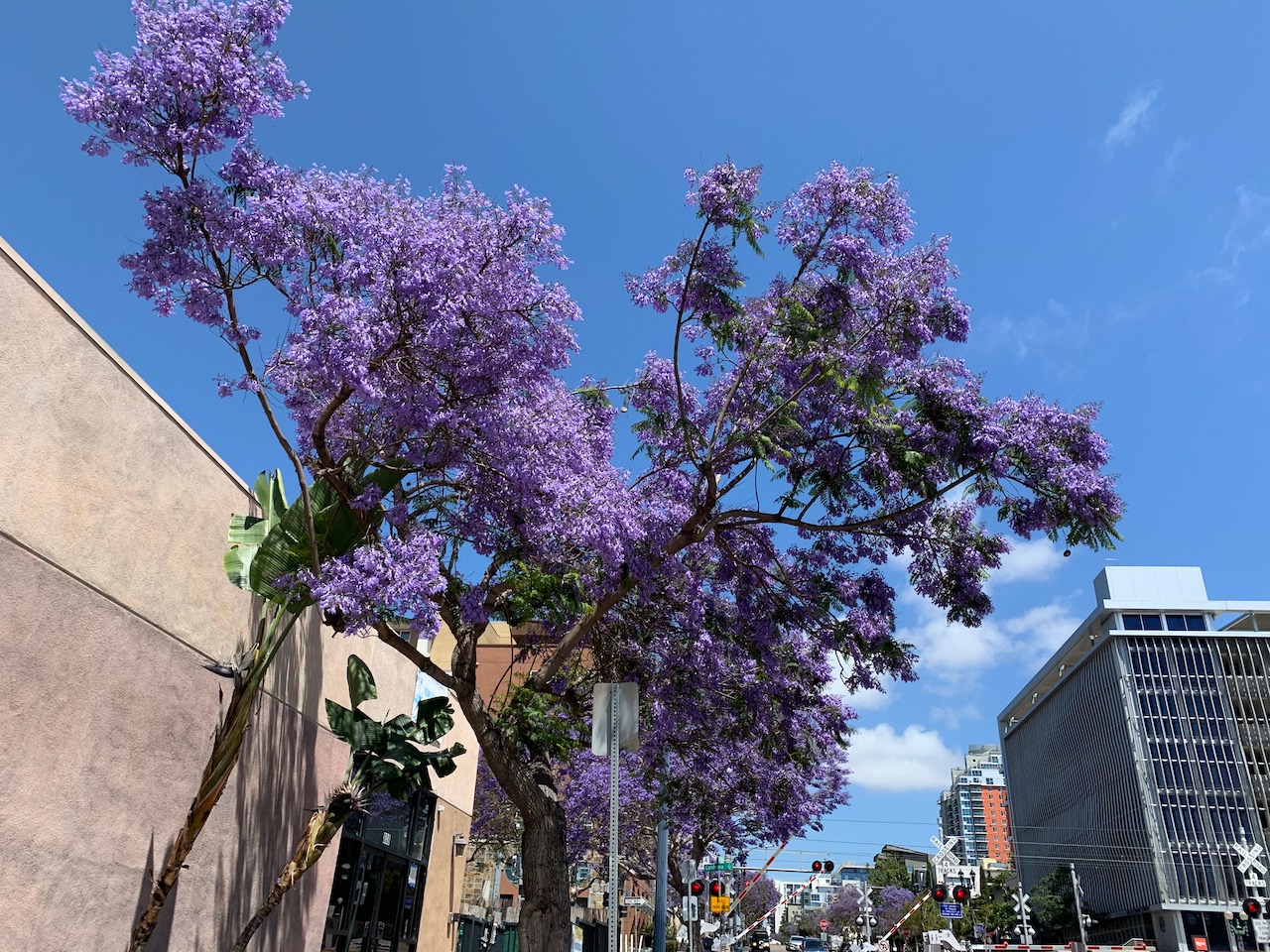
Kate Sessions was also the first person to import and plant Jacaranda trees in San Diego. Their blooming purple petals has long been a treasured sign of Spring here in our city.
Christopher Nolan’s film The Odyssey has arrived. I haven’t seen it yet but I certainly plan to do so. Homer’s Odyssey has always been one of my favorite pieces of classical literature, beginning with an illustrated children’s version I first read when I was ten years old. Since that time I’ve probably read the story in various translations a dozen times. As you’ll see from the photo below, I keep a copy of it, and its companion, The Iliad, on my shelves next to my volumes of The New Annotated Sherlock Holmes. Essential reading, at least in my home.
Some time ago, a younger and far more ambitious version of me decided to write and compose a song cycle based on The Odyssey. It’s one of my more esoteric efforts, equally inspired by the original tale as well as that epic slog of modernist literature, James Joyce’s Ulysses, and the spoken word songwriting of performance artist Laurie Anderson. Here’s my official description of the work.
Either a lo-fi concept album or a set of songs from a non-performed performance piece. Very loosely based on Homer’s Odyssey. Composed during a time when I was also working as a sound tech and theatrical sound designer. A mixture of musical influences including Laurie Anderson, Lou Reed, Philip Glass, Brian Eno, and Leonard Cohen. Recorded in my apartment using a Korg Poly-61 synthesizer, a Tascam 4-track cassette recorder, a Shure SM58 microphone, and a motley assortment of percussion instruments.
The central conceit of my story involved a man and a woman living together in a large city. They become estranged, then separate and reunite over the course of one long night. The title I came up with was Tides of the Heart. Here’s the opening song, On the Strand.
I should point out that the original versions of The Odyssey were performed by Homer in a song-like recitation, part of the rhapsode tradition. I like to think my own spoken-word/musical take on the story honors that tradition. In theory, anyway. In practice, I’ll leave it up to you to decide. To my ears it retains an offbeat, shambolic charm. A bit noisy in places, but with some lyrical heft and musicality. My favorite individual songs are Blue Sweater,Build a Home and Venus if you want to skip to the “hits”.
You can listen to Tides of the Heart in its entirety below.
However you may feel about Google and its parent company Alphabet, their maps application has been a great resource for writers (and most everyone) since it was first made available over twenty years ago. It’s pretty much a standard resource for me now when I’m working on a new book. There are two main ways I like to use it.
The first is one is to confirm the fictional geography of my book. Each Rolly Waters mystery is set in specific neighborhoods of San Diego. As a long-time resident, I’ve already visited some of the places where my characters go. Sometimes they go places I haven’t been so I’ll take a couple of hours to explore the area. I’ll write down some notes and take photographs.
Memories, notes and photos are great to have on hand but inevitably, as I’m putting my characters through their paces, a question will come up that I can’t answer. How long would it take a character to drive from one place to another?On foot?What can they see from a particular location? Questions like this pop up all the time as I’m writing. And that’s when I turn to my trusty Google Maps.
As I was writing Gillespie Field Groove I wanted two of the characters to be able to look down from a house and see an FBI raid taking place at buildings on the west side of the Gillespie Field airport. Here’s the view of the airfield I was able to find from Google Maps.
There’s several houses on the other side of the street, set back from the street on small hill. The geography worked! I could write the scene as I wanted.
Authenticity like this certainly isn’t required when you’re writing fiction, but I think it makes things more interesting, at least in the case of the Rolly Waters mysteries. I’ve had to finesse certain place descriptions sometimes but, on the whole, I usually get the geography right. And I think the books are better for it.
Which brings me to my favorite use of Google Maps. Inspiration! As I browse through areas of San Diego County I’m featuring in the next book, I’ll discover things that give me new ideas for where the story, and the characters, can go.
The climactic chapters of Ballast Point Breakdowntake place in the Coronado Islands, just off the coast of Baja California. I’d seen them in the distance for years but knew very little about them. I took a closer look on Google maps and discovered the Mexican government has two outposts on the island—Faro and Faro Sur. There’s also a well-protected cove on the northeast side of the largest island, a place where someone in a sailboat could anchor and shelter their boat. There’s a trail leading up from the cove to other government buildings on top. I glanced through comments and photographs. There were videos of pods of dolphins and stories of a 1930s casino. All sorts of ideas started popping into my head, many of which made it into the final version of the story.
Google is great of course, but what happens when you’re writing historical fiction? I go searching for historical maps. I don’t get as much information as I do from Google, but they still can be useful. Here’s an 1899 map of San Diego County I often referred to when I was working on The Deadly Stingaree.
For a closer look, click on the map.
This map helped me understand the route President Harrison’s train took during his 1891 visit (and helped me imagine how it might be diverted). I discovered names for towns I’d never heard of before—Fruitdale, Nestor and Oneonta—which have since been incorporated into larger cities such as Chula Vista and Imperial Beach. The map also gave me a sense of how uninhabited and agricultural the southern part of the county was at the time, giving me some more ways to tell the story.
Maps, maps, maps. A writer’s best friend (maybe second best after a Thesaurus).